SCOTXblog

Recent Posts

The Court’s final set of opinions for the 2026 Term [Jun. 26, 2026]

Don Cruse

The docket is cleared of argued cases (again)

This past week’s orders list brought the final decisions in argued cases this Term. The Court has met its self-imposed deadline to issue all of those opinions by June 30th.

There were, like last week, some very rare voting splits.

A majority author who wrote a concurrence to their own opinion

“Your eyes are not deceiving you,” I wrote last week. “Justice Busby wrote both a majority opinion and a concurrence to his own opinion…” I said that was only the second time in my time tracking the Court that a Justice had written separately to their own deciding opinion.

Now there are three. This week, Justice Busby wrote the opinion for the Court (and for a plurality on part of the opinion), while also writing a concurrence in the same case.

This concurrence breaks out certain issues that Justice Busby, Justice Lehrmann, and Justice Devine thought might “be explored in future cases,” while offering those future litigants “some points to consider.” That’s classic concurrence fare. I can see the logic of separating that from the main opinion, so there is less risk of it being interpreted as a holding of the Court.1 It’s just unusual to see that concurrence by the author of the lead opinion.

Vinyl fans may want to consult Justice Sullivan’s concurrence for a recommendation. He opens with a song reference — not by quoting lyrics, as is traditional such as there are traditions about pop references in judicial opinions — but by saying, “it’s better to hear for yourself. … give it a listen if you can and then turn the page.”

A second (partial) plurality opinion

The same orders included a second plurality opinion.

Justice Sullivan wrote for the Court (“unanimous”) for most of the opinion, but was joined only by three other Justices for Part II.B of the opinion.

Nine minus four is five who did not join. Three of those were silent about why, not writing or joining any separate opinion on the question.

Justice Young, joined by Justice Bland, did write a concurrence to express “why I am a touch more doubtful about the views expressed in Part II.B (which is not part of the opinion of the Court).”

A majority of the Court joined some kind of “statement regarding” the denial of a long-pending mandamus petition

In the past few years, a few Justices have been issuing a “statement regarding” one of the Court’s orders instead of formally noting a concurrence or dissent.

This case brought two separate “statements regarding,” joined by a total of five Justices.

The statement by Justice Hawkins notes that the Court “has never set out a particular standard a trial court must consider when deciding whether to stay a civil proceeding in light of a parallel criminal proceeding.” It then lays out two “impediments” to doing so in this case: (1) that the relator Hotze is no longer a criminal defendant and the person who is (Aguirre) is not a relator and (2) that it does not appear the stay in the civil case would be needed because the civil case is lagging behind the criminal process.

Justice Devine wrote a separate statement that proposes a substantive standard for when trial courts should stay a civil proceeding in light of an ongoing criminal case. He went on to “nevertheless agree with and join my colleague’s statement, which explains why the mandamus petition should be denied at this time. … The original proceeding’s current posture makes the petition a less-than-ideal vehicle for establishing such a standard.”

Final term stats are still to come

If you want to see a tentative version of the voting and opinion stats for this Term, you can reach those in the sidebar. They aren’t yet final, and the totals or percentages you see today might shift as I do cross-checks and tighten up the code that generates those live tables on the website.2

More grants under the new petition rules, and two very unusual voting splits [Jun. 19, 2026]

Don Cruse

More grants under the new petition rules

This week’s orders list brought eight more grants under the new petition rules. The Court has set these for argument in the November and December sittings.

Two very unusual voting splits

We are nearing the Court’s self-imposed June deadline to clear its docket of argued cases. This week, that crunch brought us two very unusual voting splits.1

A per curiam with a three-Justice dissent.

In In re J.D.H., a child, No. 25-0588, the Court issued a per curiam in a parental-termination case. The court of appeals had dismissed the appeal as untimely; the Court through a per curiam reversed and remanded “for a hearing on whether the petitioner’s counsel was ineffective in filing a late notice of appeal.”

But three Justices joined a signed dissent to the per curiam. Justice Sullivan, joined by Justices Young and Hawkins, would have held that the appellate courts lacked jurisdiction over a direct appeal that was as untimely as this one, no matter how sympathetic.

A majority author who wrote a concurrence to their own opinion.

Your eyes are not deceiving you. Justice Busby wrote both a majority opinion and a concurrence to his own opinion in this Medicaid-fraud case.

That doesn’t happen every day. During my time tracking the Court, the only similar example is Justice Willett concurring to his own opinion in In re Bexar County Criminal District Attorney's Office, No. 05-0613.

“What Were the Odds? A Year of Transition at SCOTX”

Don Cruse

I saw some of you when I spoke last week at the UT State and Federal Appeals CLE. My presentation, as usual, looked at the Court through the lens of numbers. Giving this kind of talk in June is always a high-wire act, in the busiest month of the Court’s opinion season. Doubly so this year with the new petition rules.

Here are the slides:

I tried to cover both parallel tracks going on at the Court, with partial-term numbers about cases filed under the old petition rules and the new rules alike. Those precise, partial-term numbers are aging fast. But my speculative guesses about the future remain un-disproven just yet.

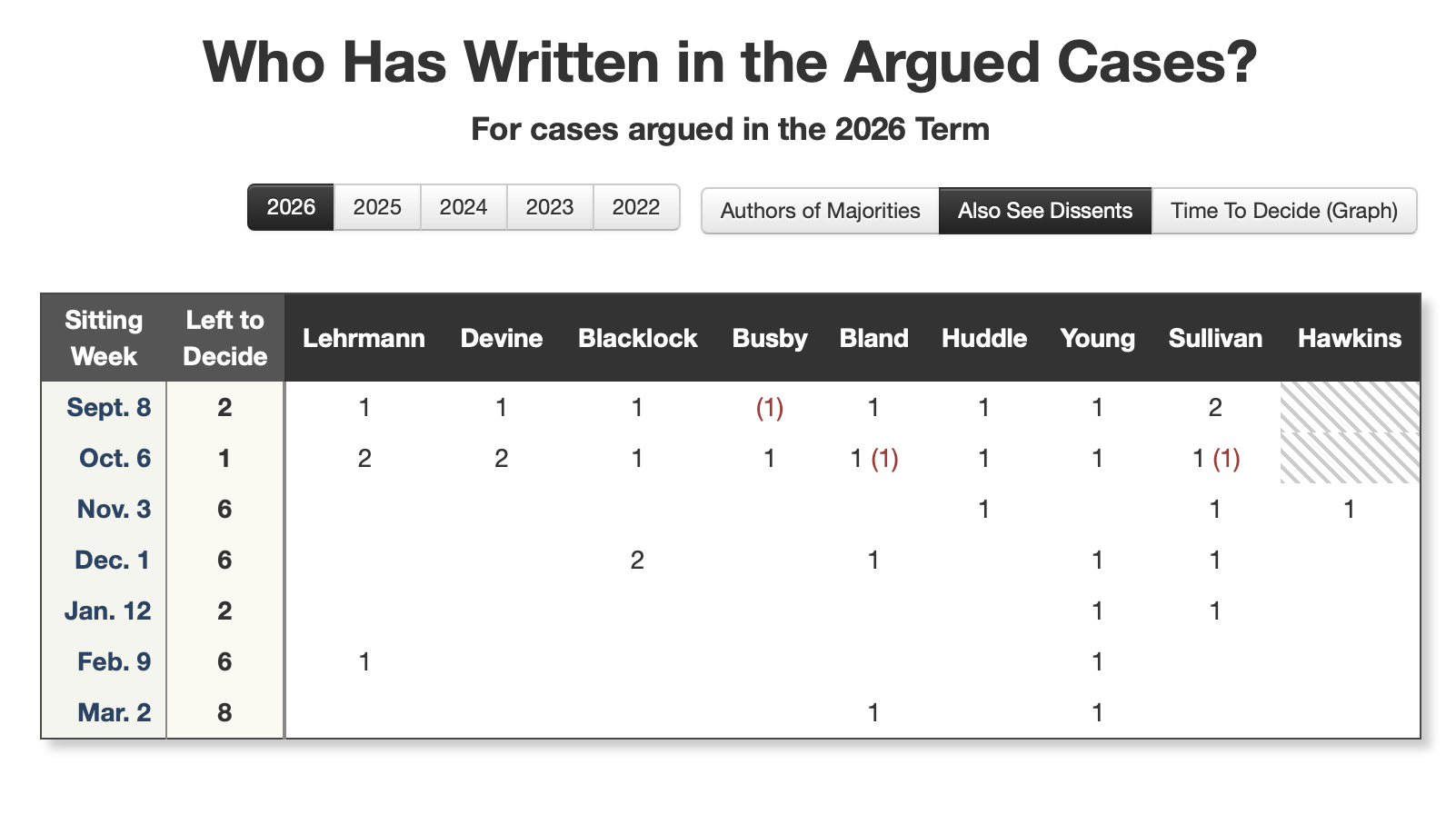
New stats feature: Who has written (and who has not) for each argument sitting?

Don Cruse

A new, grid view of the Court’s argument sittings

The tl;dr is: I’ve added a new feature to the website that lets you quickly see which Justices have written opinions for each of the Court’s argument sittings this term. My version lets you see the authors of majority opinions or, if you’d like, to also see who has written majorities or dissents for a particular sitting:

screenshot of this chart for May 14, 2026

This is wired into my docket-tracking data, so the numbers should update with each new opinion release. If you click on the date of the argument sitting, you will also reach an “argument sitting” detail page listing what cases were heard, their outcomes, and the time to decide each of them.

If this is catnip for you, welcome and enjoy. If you’re wondering who would ever want such a chart, then you can either read on or just continue blissfully with your day.

Read more about this kind of chart

We have the first grants under the Texas Supreme Court’s new petition rules

Don Cruse

This morning’s orders list brought the first grants under the Texas Supreme Court’s new petition rules.

My website has been tracking these new petitions (more on that below), so I’ve been watching for the first grant. My hope had been that the first grants might answer some questions about how the internal process might be working (and, more selfishly, give me some material for my CLE talk in June).

Here is what I’ve been tracking, and where today’s grants fit in.

What we can learn from today's first grants

The e-filing notices that led to a law firm’s disqualification

Don Cruse

… a mind’s inner workings are often opaque and its contents not easily partitioned.

A disqualification case with some cautions for appellate lawyers

Earlier this month, the Texas Supreme Court issued an attorney-disqualification opinion. The court’s guidance — and its strict rule of disqualification — actually applies to any law firm big enough to employ non-lawyer support staff.

This opinion might make you read Texas e-filing notices a little more carefully. (And the fact pattern here might make you wish that your firm’s lawyers all knew how to make e-filings themselves, rather than delegating that task to staff.)

Read the case note

Guidance from the Texas Supreme Court about how the new petition rules will work

Don Cruse

IOPs vs. “inferred” operating procedures

For a number of years, the Texas Supreme Court published a set of “internal operating procedures” (IOPs) on its website, with a detailed look at the internal process. The most recent update to that document (of which I am aware) was in 2018.1

Having published that document did not stop the Court from experimenting. As members of the Court had new ideas, or prevailed on their colleagues to revisit older ideas, the actual practice at the Court would change in ways not reflected in the IOPs. (Eventually, the Court removed that 2018 document from its website.)

See my notes on the Court's new memo

Tracking petitions under the new SCOTX rules

Don Cruse

New petition rules at the Texas Supreme Court

The big news, really, is that the Texas Supreme Court dramatically changed its petition process in January.

Under the old system, the Court’s discretionary review proceeded in two steps. First, the parties would file a petition seeking to persaude the Court to show some interest. Then the Court would request full merits briefing from both sides. Only after those months of briefing would the Court decide whether to grant review or not.

The new process in Texas is loosely modeled on the petition for certiorari process at the U.S. Supreme Court. But it’s also uniquely different. Each time I read through the redline of the new petition rules, I see some new detail that I’d like to explore. I’ll write about some of those later.

My court-tracking website is being updated to fit this new petition process

The big news, for me, is that I’ve just updated my docket-tracking website to follow cases as they move through the new process.

Get an overview of the new features

A Statpack for the Texas Supreme Court’s 2025 term

Don Cruse

“What are the Odds?” updated through 2025

The state bar appellate section invited me to speak in September 2025. As has become my own little Labor Day tradition, I updated my Texas Supreme Court stats and “What are the odds?” slides to include everything through the end of the term on August 31.

These are not only the most recent numbers covering a complete court term, they will be the last ones under the petition for review rules that had been in place since 1997. The Court has officially adopted very different petition rules effective January 1, 2026.1 So my next presentation about the court stats (in June 2026) will be trying to disentangle the numbers, about the old style of petitions and a half year of the new ones, to see what we can learn about the new system.

Read more...